Closed
Team and performance management
Turn your personal management experience into a sustainable business system.
A practical management programme. Work on your own business. Defend your final management model.
Academic Programme Director
Format
Offline
Start
30 October 2026
Language
Russian
Location
Tashkent
Duration
8 modules + project defence / 1 month of intensive study
Group
Limited places to keep the group strong
The problem is not how you work but how you think. Your role is not to fix mistakes by hand but to build a structure that runs on its own, predictably.
You are stuck in operations not because your people are weak, but because your management model rests on personal involvement rather than on architecture.
Control through fear or through “I'll do it myself” has a scaling limit. When the business grows faster than your ability to control it, the system starts to break down from within.
This is not weakness. It is a typical stress point of a strong leader.
You stop being the only pillar of the system.
You start managing through architecture: goals, roles, responsibilities and metrics.
You see the whole value chain, not isolated bursts of staff activity.
Without it: you manage blindly and hope for a lucky result
Free up to 40% of your time by delegating systemic tasks rather than functions.
Without it: every key decision comes back to you
People work not for you but for a shared result, within clear rules of the game.
Without it: the team waits for your instructions instead of taking the initiative
Scaling becomes a maths problem, not a risky gamble.
Without it: every attempt to grow leads to chaos and a loss of quality

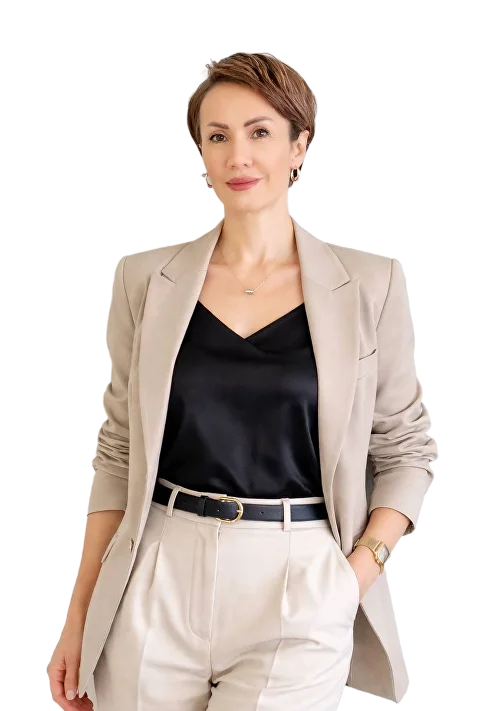
Author and Academic Director
Philosophy“Strategy is a digitised dream”
23+
years in HR
14+
years in top management
500+
HR leaders trained as part of a team
You analyse your current management model and where efficiency is lost.
You change your management logic: from personal control to working through a system.
You build a new management structure: goals, roles, responsibilities and metrics.
You defend your project as a ready management asset, not a study assignment.
You put control and automation tools in place.
You hand management over to the team and get a predictable result.
A networking dinner is part of the programme. Programme roadmap
Why business growth begins with manageability and a shift in mindset. Why manage systematically. Strategic goals map
Why the old models no longer work. Management style analysis and a list of AI tools to automate routine work
Values. Actions. Culture. Team diagnostic map
A team is built, not assembled. A map of approaches for quickly diagnosing and effectively managing the people on your team
Handing over responsibility, not tasks. Authority and responsibility matrix
What really drives results. A system of financial and non-financial motivation
Final assembly of your company's management project. Roadmap for rolling out the new management system
Presentation of the finished action plan. A ready-to-use action plan
The leader was a bottleneck: every key decision, down to choosing stationery, went through one person. High risk of error when scaling.
Company owner“I thought management was about charisma. On the programme I realised it is maths. For the first time in 5 years I went on holiday without opening the work chat once.”
“Bursts of activity” instead of steady results. It was unclear where the payroll went and why deadlines were missed.
CEO“The most valuable thing is that I got a ‘passport’ of my company. Now I can see where we lose efficiency just by looking at the dashboard. Chaos has become structure.”
“Star syndrome” among key staff. Conflicts between marketing and sales. Heavy dependence on the team's mood.
Chief operating officer“I used to hire people; now I hire functions for tasks. It completely changed the quality of the team and my relationship with my reports.”
Step out of the operational cycle and move to strategic management through vision and goals
Free up to 40% of your time by setting up autonomous business processes
Get a team that reaches its goals without micromanagement
Run the business through metrics and dashboards, relying on measurable data
Remove the business's dependence on you and the bottleneck effect
“Many of us are managers with years of experience, but today sustainable growth is only possible if you can go beyond your own experience. You need to study other companies' cases, look at problems from a different angle and discuss hard questions with experts. All of this gives you a charge of positive energy and helps new ideas emerge.”
Rano Adilova
Director, Tashkent International Medical Center • Uzbekistan
“There really are many challenges today. Competition is growing and the market itself is developing faster. Our main goal now is to move from a family-feudal type of company to a company of clear rules, regulations and procedures, and to become more systematic. I have a very simple life hack that I always follow: keep learning yourself, teach your team and study global management experience. That is why I joined this programme. It was important for me to understand the ways of solving the tasks we face, and I made sure we are on the right track.”
Mark Zingerman
Co-founder and CEO, First Development Group • Uzbekistan, Kazakhstan

“A CEO faces serious challenges in any situation: multitasking, the need to delegate and proper time management. I often face a lack of time and the need to structure work better, and without that it is impossible to take the company to a higher level. The course gave me a broader view of the qualities a CEO needs, which goals to set and how much time to spend on strategic and tactical decisions. After all, a CEO's mission is to lead the company successfully into the future. All this was possible thanks to talking with wonderful people: the course experts and the directors and founders of different companies. We all shared our stories and experience.”
Bekzod Samikzhanov
Co-founder, Safia coffee shop chain • Uzbekistan
Enrolment for this group is closed. Leave a request and we will let you know when the next intake opens.